
Operations teams should focus on growth. Not chasing updates.
AutoOps helps small and mid-size CPG and commerce brands unify tools, coordinate vendors, automate execution, and scale every stage of operations without chaos.
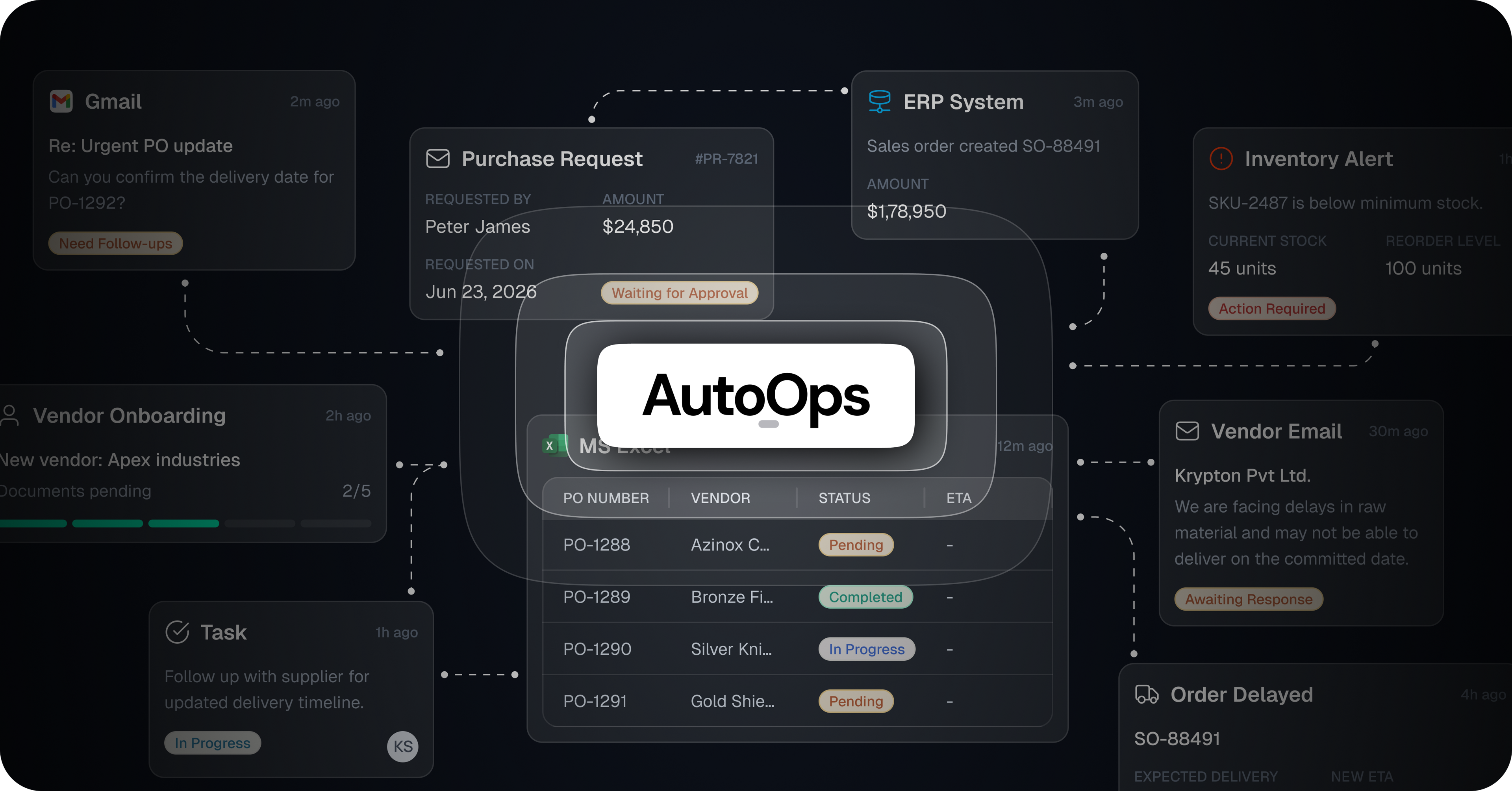
Trusted by operations teams building the next generation of consumer brands.
Improvements your top line and bottom line can feel.
AutoOps turns fragmented work into measurable operating leverage: faster execution, less manual effort, better visibility, fewer missed sales, and stronger margin control.
less manual admin work
Free operations teams from spreadsheet updates, status chasing, and repetitive coordination.
faster process execution
Move approvals, purchasing, order exceptions, and vendor workflows through defined paths.
faster reporting cycles
Give leaders live operational visibility without rebuilding dashboards by hand.
capture missed sales
Catch listing, inventory, order, and fulfillment issues before they become lost revenue.
protect profitability
Monitor costing, pricing, landed cost, vendor changes, and SKU-level margin risk.
reduce dead stock
Connect demand, inventory, procurement, and replenishment signals before cash gets trapped.
The goal is not another dashboard. It is a business that sells more, wastes less, moves faster, and scales without adding operational drag.
For teams navigating complex business transactions.
AutoOps is built for operators who need products, vendors, orders, documents, approvals, and financial context to move together.
Retailers
Coordinate product data, vendor updates, orders, store/channel execution, and exceptions across teams.
Distributors
Manage inbound inventory, supplier handoffs, order flow, service levels, and operational exceptions.
Manufacturers
Connect production, sourcing, costing, quality documents, and customer commitments in one operating layer.
Procurement teams
Run RFQs, quotes, approvals, vendor coordination, purchasing, and complex business transactions with control.
From scattered tools to synchronized action.
Disconnected workflows drain teams as data, decisions, files, tasks, and approvals multiply across separate systems. AutoOps replaces the silos with one coordinated operating flow—synchronizing context, ownership, and action so every team knows what changed and what happens next.
The operational AI layer for growing brands.
Integrate with systems of record, pare down the tech stack, automate busy work, report with ease, roll out AI workflows at scale, and point AI tokens toward higher value work.
Unify
Bring operating data, files, tasks, communications, and system records into one actionable context.
Orchestrate
Route work through governed ownership, approvals, escalations, and workflow logic automatically.
Assist
Use AI inside structured workflows so recommendations become decisions, tasks, and follow-through.
Execute
Close the loop with completed actions, logged decisions, operational memory, and live reporting.
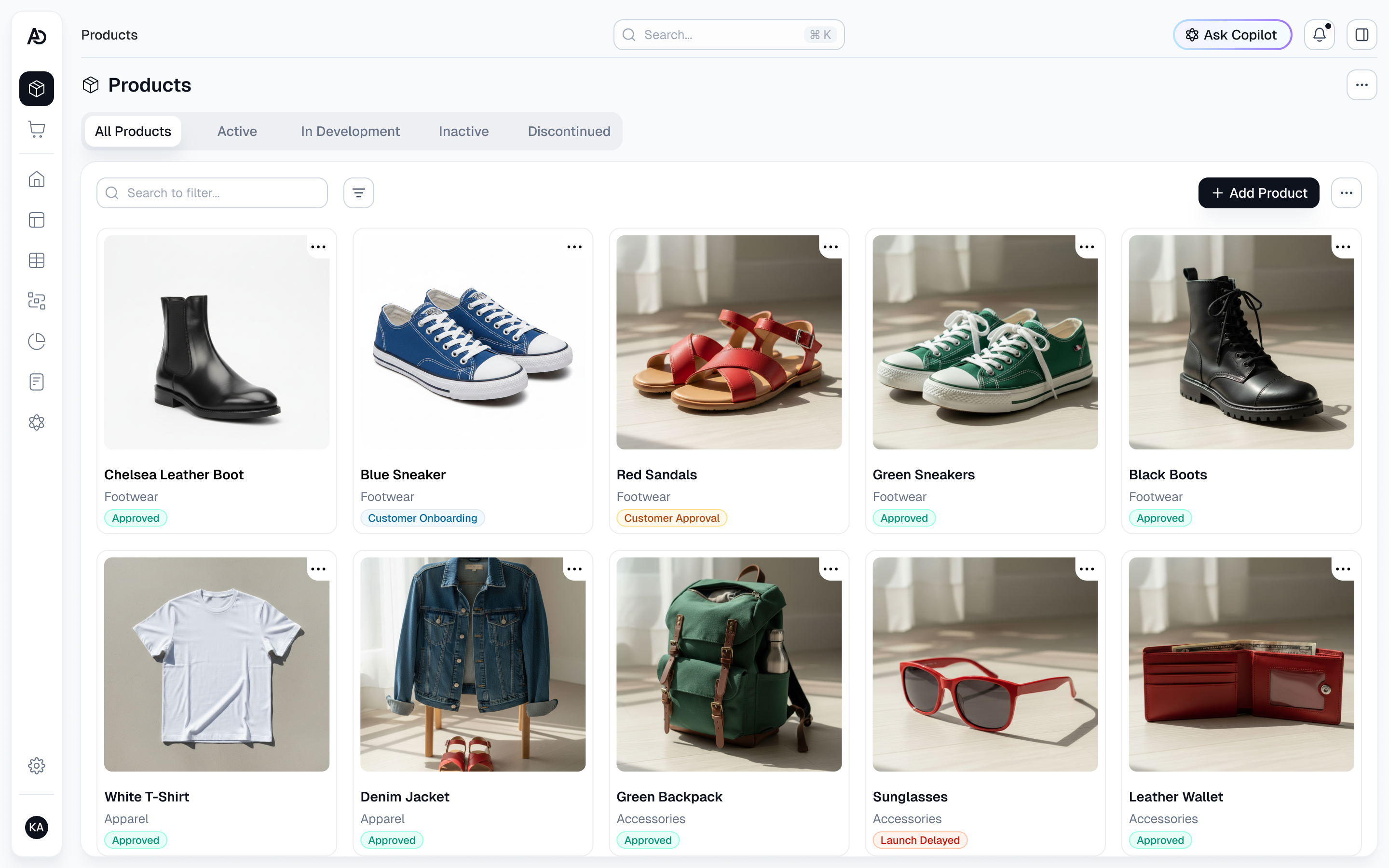
Scaling brands are surrounded by tools. Very few of them coordinate execution.
Spreadsheets, dashboards, AI tools, ERPs, ecommerce platforms, and point automations each solve part of the job. The problem is that operations lives between them.
Tools multiply faster than operating control
Spreadsheets, dashboards, AI tools, ERPs, ecommerce platforms, and point automations each solve part of the job. The problem is that operations lives between them.
Reporting explains what happened after the fact
BI gives leaders visibility, but teams still need to chase owners, update files, route decisions, and coordinate the next operational move.
AI answers questions without governed execution
ChatGPT, Claude, and Gemini can summarize, reason, and recommend. Without workflows, ownership, and controls, the answer still becomes another thing a human has to push forward.
Mini apps and automations break at scale
Prototypes and point-to-point automations help early, then become brittle when products, vendors, orders, documents, approvals, and financial context all need to move together.
Revenue scales. Coordination explodes.
Every new customer. Every new SKU. Every new supplier. Every new warehouse. Every new marketplace. Creates operational complexity.
Most companies hire more people. The best companies automate execution.
Your ERP stores information. Your BI charts. Your AI answers questions.
Who moves the work forward? Most businesses have systems of record. Few have systems of action.
AutoOps becomes the operating layer between records, reporting, AI, and execution.
 Unified Data
 Governed Workflows
 Automated Executions
 Operational Memory
 AI Assisted Actions
 Live Reporting
 Vendor Coordination
 Margin Protection
 Sheets
 Excel
Excel Claude
 Zapier
 n8n
n8n ChatGPT
 Tableau
 Salesforce
Your brand is the center. AutoOps is the support layer that scales your process.
As the brand adds SKUs, selling channels, demand signals, suppliers, orders, warehouses, and logistics partners, AutoOps supports the operating processes around the brand without becoming another silo.

Items, specs, packaging, files, variants, launch readiness, and product approvals stay connected.
Listings, retailer requests, marketplace updates, wholesale needs, and channel exceptions stay aligned.
Sales signals, forecasts, inventory risk, replenishment needs, and launch demand feed the same plan.
RFQs, supplier options, samples, landed cost, quote approvals, and margin decisions move together.
Supplier updates, scorecards, documents, compliance, co-manufacturer work, and follow-ups stay visible.
Customer orders, allocation, exceptions, approvals, changes, and handoffs move through owned workflows.
Inventory, releases, warehouses, inbound shipments, carriers, documents, and delays stay coordinated.
Signals across products, channels, vendors, demand, and orders become dashboards and action.
Set up products, suppliers, files, tasks, and core workflows around the brand.
Add channels, demand signals, vendor work, and orders without losing context.
Standardize cross-functional processes while keeping current systems in place.
Coordinate global vendors, logistics, fulfillment, finance, and AI-enabled operations.
AutoOps does more than automate workflows. It gives teams the place to do the work.
Projects, tasks, communications, and files live inside the operational context they belong to, so every update stays attached to the record, process, customer, vendor, or launch it supports.
Launches, sourcing initiatives, onboarding, milestones, dependencies, and owners.
Approvals, exceptions, POs, vendor requests, and operational follow-ups.
Comments, approvals, status updates, and decisions tied to operational records.
Specs, certifications, invoices, vendor documents, images, and operating files.
Work seamlessly with the tools already in your business.
AutoOps integrates with the systems brands already depend on, then adds the orchestration layer those tools were never designed to provide.
 Salesforce
 HubSpotCRM
Sales information, opportunities, customer requests, retailer commitments.
 NetSuite
 SAPERP
P&L information, items, purchase orders, inventory, and system-of-record transactions.
 Shopify
 AmazonEcomm
SKU listings, channel content, sales orders, marketplace exceptions, fulfillment signals.
 QuickBooks
 XeroAccounting
P&L context, invoices, bills, accruals, margin signals, and close workflows.
 ChatGPT
 ClaudeAI
Data retrieval, document processing, analytical reasoning, and recommended next actions.
 Slack
Slack Teams
Teams DriveProductivity
Central source of truth for tasks, files, communications, approvals, and ownership.
Stop managing operations. Start scaling execution.
See how AutoOps helps modern brands eliminate coordination overhead, streamline execution, and prepare for the future of AI.